
Getting Started · Beginner · 6 min read
The Smith Machine: What It's Good For, What It Isn't, and the Best Exercises
The Smith machine is the most argued-about piece of equipment in any gym — half of lifters swear by it, the other half call it a waste of iron. Both are partly right. The fixed bar path changes what the exercise is, and once you understand exactly what it removes and what it adds, picking the right jobs for it becomes obvious.
On this page
What a Smith machine actually is
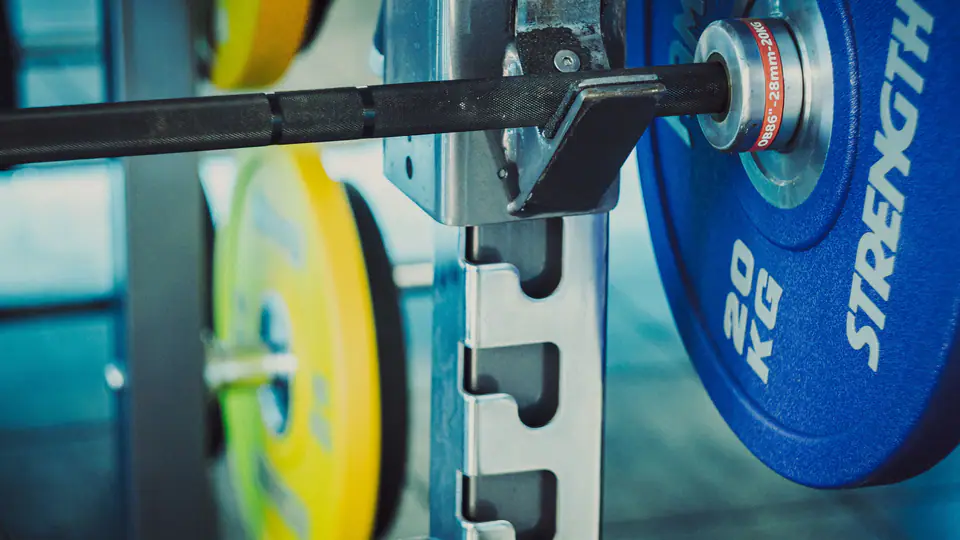
The bar travels on a fixed track. Instead of controlling a barbell in three dimensions, you push against a guided line and simply turn the wrists to hook or unhook at almost any height. Many commercial machines also have a counterbalanced bar, so the empty bar can weigh as little as a few kilos instead of twenty.
Those two facts — the guided path and the adjustable racking — explain everything the machine is good at and everything it is not.
Smith machine vs free weights
| Trait | Smith machine | Free weights |
|---|---|---|
| Balancing the load | Done for you | You do it |
| Bar path | Fixed, one line | Your body decides |
| Stabiliser muscles | Largely switched off | Fully trained |
| Racking mid-set | Anywhere, any time | Rack or floor only |
| Load progression | Easy and precise | Easy and precise |
| Learning cost | Very low | Moderate |
The fixed path is the whole trade. It makes exercises easier to learn and safer to push to failure alone — and it stops your body from having to control the bar, which is a meaningful part of what makes free-weight training functional. For the general case on machines versus iron, see free weights vs machines.
Where the Smith machine earns its place
The exercises that flatter it most are the ones whose natural bar path is already a straight line, or where path does not matter:
| Exercise | Why it suits the machine |
|---|---|
| Split squat / Bulgarian split squat | Fixed path lets you drive hard without balancing |
| Calf raise | Standing calf raises without the balance tax |
| Shrug | Heavy traps work with instant racking |
| Bench press | Push to failure alone, rack with a wrist turn |
| Hip thrust | Easier setup and loading than a free bar |
| Row and shrug variations | Consistent line, safe when fatigued |
The other genuine advantage is training alone. The hooks mean you can take a set to failure on a bench press and rack it safely at any point — something a free bar only offers with a spotter or a power rack set correctly. For the wider machine picture, see the gym machine guide.
Where it falls short
The fixed path is a problem when it fights your body. People are built differently — leg lengths, torso lengths, hip anatomy — and a squat forced along a vertical line can pull the knees and lower back out of their comfortable path. If an exercise feels wrong in the machine, it is the machine disagreeing with your skeleton, and that is worth respecting.
Two more real limits:
- No stabilisation training. The muscles that keep a free bar balanced do nothing here, so strength built purely in the machine transfers less well to free-weight performance.
- A false sense of load. Counterbalanced bars and fixed paths let you move more weight than the free version — a fine thing for ego, a misleading one for tracking progress.
Big barbell movements — the squat, the deadlift, the bench — are best learned and mostly trained with free weights, machines as accessory.
Using it in a real program
- Use it for the moves whose path already suits it — split squats, presses, shrugs, calf raises
- Set the hooks at the right height before the set, and know the rack motion cold
- Keep your body where the bar wants to travel — do not force your anatomy to the rails
- Pair machine work with free-weight work, not instead of it
- Chase Smith machine PRs as if they were squat and bench PRs
- Grind reps with locked hooks and no spotter arms
- Let the counterbalanced bar flatter your numbers without telling you
- Skip free weights entirely because the machine feels safer
In practice, the machine slots in as a second movement or a hard finisher: free-weight squat first, Smith split squats after; bench press first, Smith press for a drop set. That arrangement keeps the stabilisation practice in the program and uses the machine for what it is — a way to push a target muscle hard, safely, alone.
Two safety details: set the hooks at a height you can rack at any moment, and use the spotter arms for pressing movements. The wrist turn that racks the bar is the machine's whole gift — make sure your hands know it before the set gets heavy.
Track it honestly
- A Smith machine fixes the bar path and removes balancing — that trade is the whole story.
- It flatters split squats, presses, shrugs, calf raises and hip thrusts; it suits big lifts less.
- Its superpower is training hard, alone, to failure — the hooks make racking safe at any point.
- Fixed paths can fight your anatomy; an exercise that feels wrong in the machine is the machine, not you.
- Use it beside free weights, not instead of them — and track the numbers separately.
Frequently asked questions
Is the Smith machine as good as free weights?
For muscle growth, close — studies comparing the two for hypertrophy are surprisingly even. For strength that transfers to free barbells and for the stabilising muscles around every joint, free weights win. Most lifters benefit from both.
Are Smith machine squats bad for your knees or back?
Not inherently, but the fixed vertical path forces every skeleton into the same line. If your build suits it, the machine squats fine; if it forces your knees or lower back out of their natural path, switch to split squats or use a free bar — the exercise should fit the body, not the reverse.
Can you build muscle with a Smith machine?
Yes. Load, reps and sets can all progress inside a stable, safe path, which is most of what hypertrophy needs. Bodybuilders have built physiques on machines for decades — the cost is simply less stabilisation training and less carry-over to free lifts.
Should beginners use the Smith machine?
It is a fine place to start: the guided path lowers the skill barrier and makes solo training safe. Just do not stay there forever — learning the free-weight versions of the big lifts early builds the balance and control the machine quietly skips.
Related guides
Free Weights vs Machines: Which Is Better?
Free weights vs machines for building muscle and strength — the real pros and cons, what the research says, and how to use both for the best results.
Beginner · 3 min read
Gym Machines: What Each One Does and Where to Start
A beginner’s guide to gym machines: what the main stations train, how to set every machine up in seconds, and how they fit around free weights.
Beginner · 3 min read
Squat Form: How to Squat With Proper Technique
How to squat with proper form: setup, bracing, depth, knees and common mistakes. A step-by-step guide to a safe, strong barbell back squat.
Beginner · 5 min read
Leg Press Form: Quads, Glutes and Safe Depth
Leg press form, step by step: seat and foot placement, how deep to go, knee tracking, lower-back safety, and how to build bigger quads and glutes.
Beginner · 4 min read
This guide is general educational information, not medical advice. Train within your ability and consult a qualified professional before starting a new program if you have an injury or health condition.