
Lifting Technique · Beginner · 4 min read
Push-Up Form: How to Do a Proper Push-Up
The push-up is the most performed and most poorly performed exercise in the world. Done well it is a genuine chest, shoulder and triceps builder that also teaches you to hold a rigid trunk. Done badly it is a neck exercise. The difference is about five details.
On this page
Muscles worked
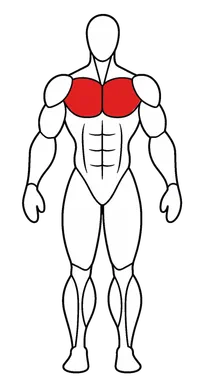 Chest — the prime mover
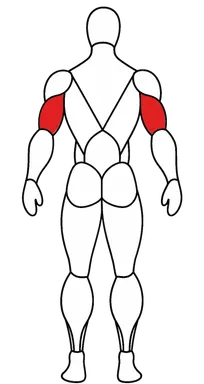 Triceps — elbow extension
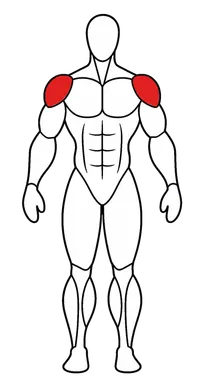 Front delts — shoulder flexion
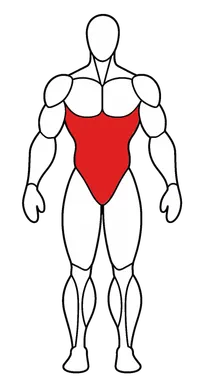 Abs — hold the plank
A push-up is a moving plank. If the trunk gives, the exercise stops training the chest and starts hurting the lower back.
The setup and the rep
- Hands slightly wider than the shoulders, under the upper chest, not the face.
- Turn the hands out a few degrees and grip the floor with the fingers.
- Set the feet hip-width. Squeeze the glutes and brace the abs.
- Make a straight line from the ear to the ankle, and keep it the whole set.
- Lower until the chest is a fist's height from the floor, elbows at about 45 degrees.
- Push the floor away and finish with the shoulder blades spread, not pinched.
Common push-up mistakes
- Hips, ribs and head move as one piece
- Full depth: chest close to the floor every rep
- Elbows at roughly 45 degrees from the body
- Hips sagging, which turns it into a lower-back exercise
- Head reaching for the floor before the chest does
- Half reps once fatigue sets in — stop the set instead
- Flaring the elbows straight out to the sides
Easier and harder versions
The push-up is a leverage exercise: change the angle and you change the load. There is a version for everyone.
- Wall push-upAlmost no load — learn the body line
- Incline on a bench or tableAround 40 to 55 percent of bodyweight
- Knee push-upShorter lever, full upper-body range
- Standard push-upRoughly 65 percent of bodyweight
- Feet elevated70 percent and up, more upper chest
- Archer or one-arm progressionsAdvanced, one side at a time
Knee push-ups are a legitimate starting point, but an incline push-up is usually better: it keeps the full-body plank that makes the exercise valuable.
How many should you do
Train them like any other exercise: three to four sets, stopping two or three reps short of failure, in a range you can control. If you can do more than about 20 clean reps, move to a harder version rather than chasing a bigger number — the reasoning is in progressive overload.
- A push-up is a moving plank — brace the trunk or the exercise stops working the chest.
- Hands under the upper chest, slightly wider than the shoulders.
- Elbows at about 45 degrees, not flared to 90.
- Chest to a fist above the floor; half reps do not count.
- Past roughly 20 clean reps, change the leverage rather than adding reps.
Frequently asked questions
How low should you go on a push-up?
Until your chest is about a fist height from the floor, with the elbows travelling behind the body. Cutting the range short is the most common way people stall.
Are knee push-ups effective?
They work, but an incline push-up against a bench or worktop is usually a better starting point: it keeps the whole-body plank that makes the exercise valuable, and it scales down smoothly as you lower the surface.
How much of your bodyweight is a push-up?
Roughly 65 percent of bodyweight in the standard position, dropping to around 40 to 55 percent on an incline and rising above 70 percent with the feet elevated.
Why do my wrists hurt during push-ups?
Usually the wrist is bent too far under load. Grip the floor with your fingers to spread the pressure, turn the hands out slightly, or use push-up handles or dumbbells to keep the wrist straight.
Related guides
Bench Press Form: How to Bench Press Properly
How to bench press with proper form: grip, arch, bar path, leg drive and the common mistakes. A step-by-step guide to a safe, stronger bench.
Beginner · 4 min readBodyweight Training: How to Build Muscle With No Equipment
How to build real muscle with bodyweight training: the six patterns without a gym, how to make an exercise harder, and a three-day plan you can run anywhere.
Beginner · 5 min readCommon Lifting Form Mistakes (and How to Fix Them)
The most common weightlifting form mistakes — ego lifting, half reps, using momentum, poor bracing — and simple fixes to train safely and effectively.
Beginner · 3 min readHow to Build a Bigger Chest
How to build a bigger chest: the best chest exercises, training all areas of the pecs, ideal volume and reps, and the mistakes that stall chest growth.
Beginner · 3 min read
This guide is general educational information, not medical advice. Train within your ability and consult a qualified professional before starting a new program if you have an injury or health condition.