
Programs & Splits · Beginner · 4 min read
Jump Rope Workout: Cardio That Builds Coordination
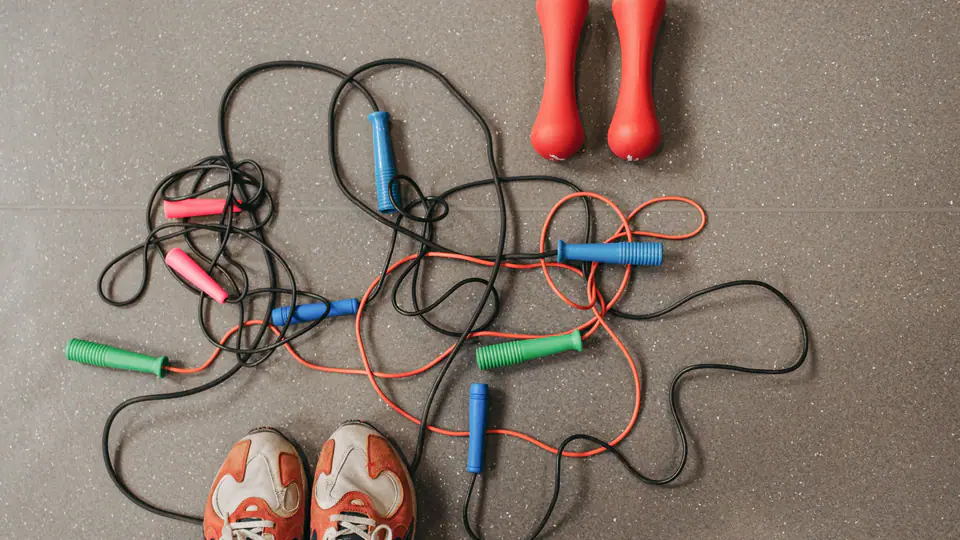
A jump rope costs almost nothing, fits in a bag, and delivers one of the toughest conditioning sessions in the gym. Ten minutes of honest rope work rivals far longer sessions on machines. Here is how to start without spending it tripping.
On this page
Why jump rope works
The rope punishes rhythm rather than lungs — you cannot cheat a rope, which is why it feels brutal at first and easy after a month. It trains the calves, shoulders and grip lightly, improves bounce and coordination for other sports, and needs a square of floor.
- 10–16calories per minuteComparable to hard running
- 10–20minutes per sessionEnough — rope is dense work
- 3×per weekConditioning without clobbering recovery
- ~0equipmentA rope and a floor
How to start without tripping
Almost every beginner problem is the same: jumping too high, arms too wide, rope the wrong length. Fix the setup first:
- Length — stand on the middle; the handles reach your armpits.
- Wrists, not arms — the turn comes from the wrists, elbows near the ribs.
- Low jumps — clear the rope by 2 to 3 cm, landing soft on the balls of the feet.
- Look forward, not down at the rope.
Start with 30 seconds on, 60 seconds off, for 10 rounds. Trip often and keep going — the rope forgives fast.
- Handles turned by the wrists, elbows close to the ribs
- Small, soft bounces on the balls of the feet
- A rope sized to your armpits
- Short rounds with honest rest while learning
- Jumping high like a boxer in a movie
- Swinging the whole arm to turn the rope
- A rope that drags on the floor
- Grinding 20-minute rounds on day one
The workouts
Three formats, from beginner to brutal:
- Warm-up2 min easy bouncing
- Rounds 1–430s jump / 60s rest
- Rounds 5–845s jump / 45s rest
- Rounds 9–1030s fast / 30s rest
- Cool-down2 min walk and stretch
Once 30-on-60-off is easy, try intervals: 60 seconds on, 30 off. Or the classic: 100 skips, then 10 squats, 10 push-ups, 10 sit-ups — repeat for 10 rounds. Rope pairs beautifully with bodyweight work.
- Cardio only2–3 sessions of 15 minOn non-lifting days or after
- Fat-loss phase3× per week as the HIIT slotSee cardio for fat loss
- Sport conditioningBefore practice, 10 minCoordination and warm-up in one
- Bad kneesSkip rope, use a bikeRope is impact work
What it does for fat loss
Rope burns serious calories per minute, but it does not out-eat a bad diet. Use it as the hard cardio slot inside a deficit and it earns its place — especially because it is fun enough to repeat. Keep the sessions short and sharp.
- Jump rope is dense conditioning: 10 to 16 calories a minute plus coordination.
- Size the rope to your armpits and turn it with the wrists, not the arms.
- Start with 30 seconds on, 60 off; the skill comes in weeks, not days.
- Two or three 15-minute sessions a week sharpen conditioning without hurting lifting.
- Rope is impact work — pick a bike instead if the knees complain.
Frequently asked questions
Is jump rope good for fat loss?
Yes — it burns calories at a rate comparable to hard running and is easy to do anywhere. But the deficit still decides fat loss; rope is the tool, not the answer.
How long should a jump rope workout be?
Ten to twenty minutes is plenty. Rope is high-density work; a 15-minute session with intervals beats a long, tired shuffle.
Why do I keep tripping on the rope?
Usually a rope that is too long or short, arms swinging wide, or jumping too high. Check the length, turn with the wrists, and keep the bounce small.
Can I jump rope every day?
Two or three times a week is a better target — the calves, ankles and feet need recovery from impact. Daily rope is fine only when the volume is low and nothing else is pounding the legs.
Related guides
HIIT Workouts: What They Are and When They Actually Help
What HIIT really is, how it compares with steady cardio for fat loss, how to build an interval session, and how much you can do without wrecking your lifting.
Intermediate · 4 min read
Cardio for Fat Loss: HIIT vs LISS
Cardio for fat loss explained: HIIT vs steady-state (LISS), how much cardio you need, and how to add it without hurting your lifting and recovery.
Intermediate · 4 min read
Home Workouts: Build Muscle With Minimal Equipment
How to build muscle at home with minimal equipment: bodyweight training, dumbbells and bands, progressive overload without a gym, and a sample routine.
Beginner · 3 min read
How to Warm Up and Cool Down for Lifting
A simple, effective warm-up and cool-down routine for the gym: raise your temperature, prime the movement, and recover — without wasting time.
Beginner · 3 min read
This guide is general educational information, not medical advice. Train within your ability and consult a qualified professional before starting a new program if you have an injury or health condition.