
Muscle-Group Guides · Beginner · 4 min read
How to Get Bigger Arms: Biceps and Triceps
Bigger arms are one of the most common training goals — and one of the most misunderstood. The secret is not endless biceps curls. Here is how to actually build impressive arms by training both heads of the equation correctly.
On this page
Triceps are most of your arm
The triceps make up roughly two-thirds of your upper arm size — more than the biceps. If you want bigger arms, the triceps deserve at least as much attention as the biceps, yet they are often neglected. Prioritize triceps work and your arms will grow faster than from curls alone.
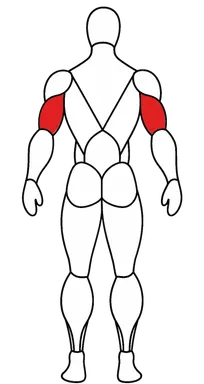 Triceps — about two thirds of the arm
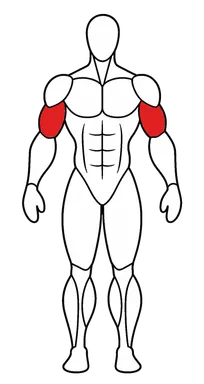 Biceps — the front, and the smaller half
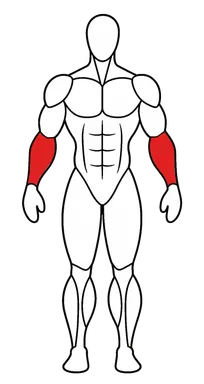 Forearms — grip, and visible arm thickness
Best triceps exercises
Train the triceps with a mix of pressing and extension movements:
- Close-grip bench press and dips — heavy compound triceps builders.
- Overhead triceps extensions (dumbbell, cable or EZ-bar) — emphasize the long head with a stretch.
- Triceps pushdowns — great for controlled volume and the pump.
Include an overhead (stretched) movement, since the long head responds well to it.
Best biceps exercises
For the biceps, cover different angles:
- Barbell or EZ-bar curls — heavy overall biceps work.
- Dumbbell incline curls — train the biceps in a stretched position.
- Hammer curls — develop the brachialis and forearm, adding arm thickness.
Vary grip and angle, and control the lowering phase for a full stretch.
How to train arms for growth
Apply the muscle-building basics:
- Train arms with about 10 to 16 hard sets per muscle (biceps and triceps) per week.
- Use mostly 8 to 15 reps, taken close to failure.
- Emphasize full range of motion and the stretched position.
- Apply progressive overload and track your lifts.
Arms also get indirect work from pressing and pulling, so count that toward your total.
- MonPushTriceps: 4 sets after pressing
- TuePullBiceps: 4 sets after rowing
- WedLegs
- ThuRest
- FriPushTriceps: 4 sets, different angle
- SatPullBiceps: 4 sets, different angle
- SunRest
That is 8 hard sets per muscle per week, which is enough for most people — and it needs no extra session.
Why your arms might not be growing
Common reasons arms lag:
- Neglecting triceps in favor of biceps.
- Using momentum instead of controlled reps.
- Too little volume or effort (not training close to failure).
- No progressive overload over time.
- Not eating enough to support muscle growth.
Fix these and arms respond well, since they recover quickly and can be trained frequently.
- Both heads of the biceps and all three of the triceps get direct work
- Sets taken close to failure, with a controlled lowering
- The same exercises long enough to add weight to them
- Total calories high enough to grow anything at all
- Only curls, no overhead triceps work
- Swinging the weight so the arm barely does anything
- Six exercises today and six different ones next week
- Expecting arm growth during a calorie deficit
- Dose-response between weekly resistance-training volume and muscle mass (Schoenfeld et al., 2017) J Sports Sci
- Strength and hypertrophy with low vs. high loads: a meta-analysis (Schoenfeld et al., 2017) J Strength Cond Res
- Proximity to failure and hypertrophy: a systematic review with meta-analysis (Refalo et al., 2023) Sports Med
- ISSN Position Stand: Protein and Exercise (Jäger et al., 2017) JISSN
- Triceps are about two-thirds of arm size — prioritize them.
- Train triceps with presses, dips and overhead extensions.
- Train biceps with curls across different grips and angles.
- Aim for 10 to 16 hard sets per arm muscle weekly, close to failure.
- Control reps, use a full range, and apply progressive overload.
Frequently asked questions
How do I get bigger arms fast?
Prioritize the triceps (two-thirds of arm size), train both biceps and triceps with 10 to 16 hard sets each per week close to failure, use full range of motion, apply progressive overload, and eat enough to grow.
Are biceps or triceps more important for arm size?
Triceps. They make up roughly two-thirds of your upper arm, so neglecting them limits arm size. Train triceps at least as hard as biceps for the biggest arms.
How often should I train arms?
Twice a week is a good target for growth, since arms recover quickly. They also get indirect work from pressing and pulling, which counts toward your weekly volume.
Why are my arms not growing?
Usually too little triceps work, using momentum instead of control, insufficient volume or effort, no progressive overload, or not eating enough. Address these and arms typically respond well.
Related guides
How to Build Muscle: The Complete Hypertrophy Guide
How to build muscle, explained simply: the three drivers of growth, how much to train and eat, how fast you can gain, and the mistakes to avoid.
Beginner · 5 min readTraining Volume for Muscle Growth: How Many Sets?
How many sets per muscle per week build the most muscle? A practical guide to training volume, the optimal range, and how to add volume without overtraining.
Advanced · 4 min readHow to Build a Bigger Chest
How to build a bigger chest: the best chest exercises, training all areas of the pecs, ideal volume and reps, and the mistakes that stall chest growth.
Beginner · 3 min readHow to Build a Wider, Thicker Back
How to build a bigger back: training for width and thickness, the best vertical and horizontal pulling exercises, ideal volume, and common mistakes.
Intermediate · 3 min read
This guide is general educational information, not medical advice. Train within your ability and consult a qualified professional before starting a new program if you have an injury or health condition.